News > Blog
Uniting for Change: Community-Driven Solutions to Prevent Child Marriage
Published 06/13/2025 by Global Communities

Sanjay Dubey, a high school teacher in the Palamu district of Jharkand, India, was taking attendance for his 9th grade class when he noticed something unsettling — Shreya*, one of his students, had been absent for five consecutive days.
This wasn’t an isolated case. Time and again, Sanjay had watched girls in grades 9 and 10, typically just 16 or 17 years old, quietly vanish from school. No farewell, no explanation. Eventually, the same reason would emerge: they had been married off and forced to quit their education.
Jharkhand has some of the highest rates of child marriage in India, where girls from poor socio-economic backgrounds are often married off early by their families due to financial hardship and limited opportunities. PCI India, a Global Communities Partner, is working to prevent this issue through Project Umang, an initiative focused on using women’s collectives to raise awareness about alternative pathways.

Breaking the cycle through community action
Determined not to let Shreya become another statistic, Sanjay spoke with her classmates and confirmed his fear: her marriage had been arranged. Without wasting time, he contacted Sandhya Devi, a Gender Community Resource Person (CRP) trained through Project Umang. If anyone might be able to step in and change the outcome, it was her.
“When I received the information from the school, I realized that we had to act fast, as the girl was going to be engaged on the same day,” said Sandhya, who works with the Jharkhand State Livelihood Promotion Society (now known as “Palash”). PCI India has been implementing Project Umang in partnership with Palash since 2019.
After speaking to Shreya’s mother, Sandhya learned that the parents were marrying off their eldest daughter to ease financial burdens. They did not see the harm in continuing what was a common community practice.
“On this, we pointed out that times have changed and reminded her of the evils of child/early marriage — how a girl’s education, health, career and economic independence suffered with child marriage,” Sandhya said. “We also made her realize her potential as a mother in improving her daughter’s future.” After a long conversation, Shreya’s mother agreed to challenge her daughter’s impending marriage. While willing to negotiate with her own family and the groom’s family, she recognized she would need support convincing them at this stage.
That support came through Project Umang.
Menka, another Gender CRP associated with the initiative, conducted a home visit to engage both families in dialogue. She carefully informed them about the legal implications under the Prohibition of Child Marriage Act and the potential consequences of proceeding with an underage marriage. More importantly, she spoke candidly about the long-term impact that early marriage would have on Shreya’s future — her education, her health and her ability to lead a self-determined life.
Her words resonated. Soon, members of the community and local leaders joined in support, reinforcing the urgency of Menka’s message. Their unified voice turned the tide. In the end, both families agreed to call off the wedding.
beyond intervention: creating pathways for progress
For Menka and fellow CRP Sandhya, the outcome marked an important victory in a region where child marriage is often seen as tradition. They credit the intensive training they received through Project Umang for giving them the tools and confidence to intervene — and to make change where it once seemed impossible.
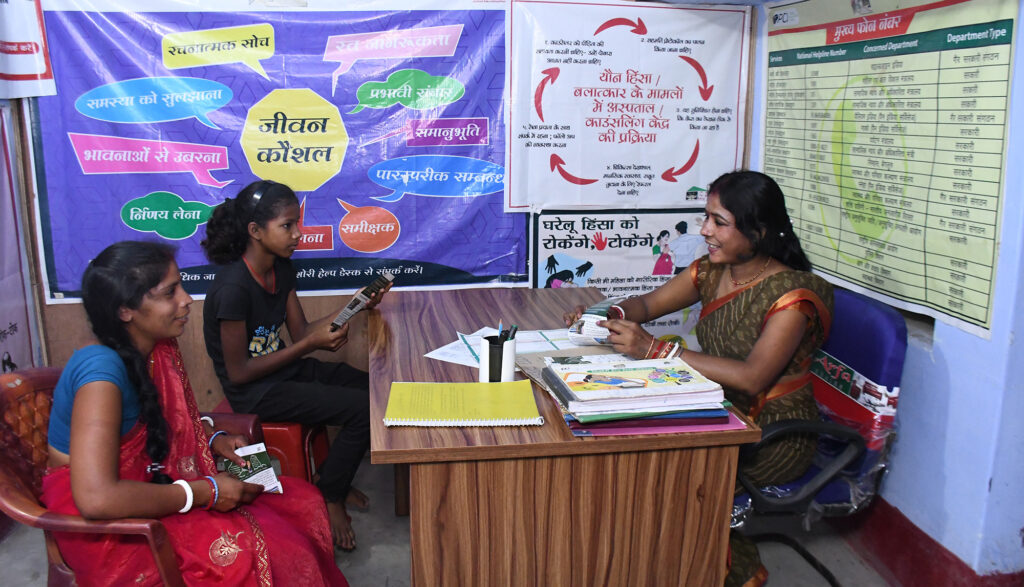
“The best part about Umang is that it isn’t limited to only stopping child/early marriages. Rather, it takes a step ahead and offers guidance to adolescent girls and their parents on alternative pathways,” said Sandhya, referencing another component of the project known as the Kishori Help Desk. Under this platform, Umang offers community-based counseling services on career, education and life skills as well as scholarship opportunities. To date, the project has launched a total of 15 Kishori Help Desks.
“With Umang, we are gradually taking the message around gender issues — especially around girls’ education and child marriage — as far as we can reach out,” said Menka, who is one of more than 400 Gender CRPs in Jharkhand.
Meanwhile, Shreya is happy to be back in school, where she successfully appeared for her final exams and was promoted to 10th grade. She is deeply grateful to her teacher and the Umang team for safeguarding her future and aspires to continue her education.
*Name has been changed to protect privacy.